I have changed the way I blog and
have moved to Tumblr

Showing posts with label Poetry. Show all posts

Tuesday, February 12, 2013

Edvard Munch (1863 - 1944)


In a dark time, the eye begins to see,
I meet my shadow in the deepening shade;
I hear my echo in the echoing wood--
A lord of nature weeping to a tree,
I live between the heron and the wren,
Beasts of the hill and serpents of the den.

What's madness but nobility of soul
At odds with circumstance? The day's on fire!
I know the purity of pure despair,
My shadow pinned against a sweating wall,
That place among the rocks--is it a cave,
Or winding path? The edge is what I have.

A steady storm of correspondences!
A night flowing with birds, a ragged moon,
And in broad day the midnight come again!
A man goes far to find out what he is--
Death of the self in a long, tearless night,
All natural shapes blazing unnatural light.

Dark,dark my light, and darker my desire.
My soul, like some heat-maddened summer fly,
Keeps buzzing at the sill. Which I is I?
A fallen man, I climb out of my fear.
The mind enters itself, and God the mind,
And one is One, free in the tearing wind.
Theodore Roethke (1908 - 1963)
In a Dark Time


Tuesday, February 05, 2013

My true love hath my heart


My true love hath my heart, and I have his,
By just exchange one for another given:
I hold his dear, and mine he cannot miss,
There never was a better bargain driven:
My true love hath my heart, and I have his.

His heart in me keeps him and me in one,
My heart in him his thoughts and senses guides:
He loves my heart, for once it was his own,
I cherish his because in me it bides:
My true love hath my heart, and I have his.
Philip Sidney (1554 - 1586)
The Bargain


Saturday, February 02, 2013

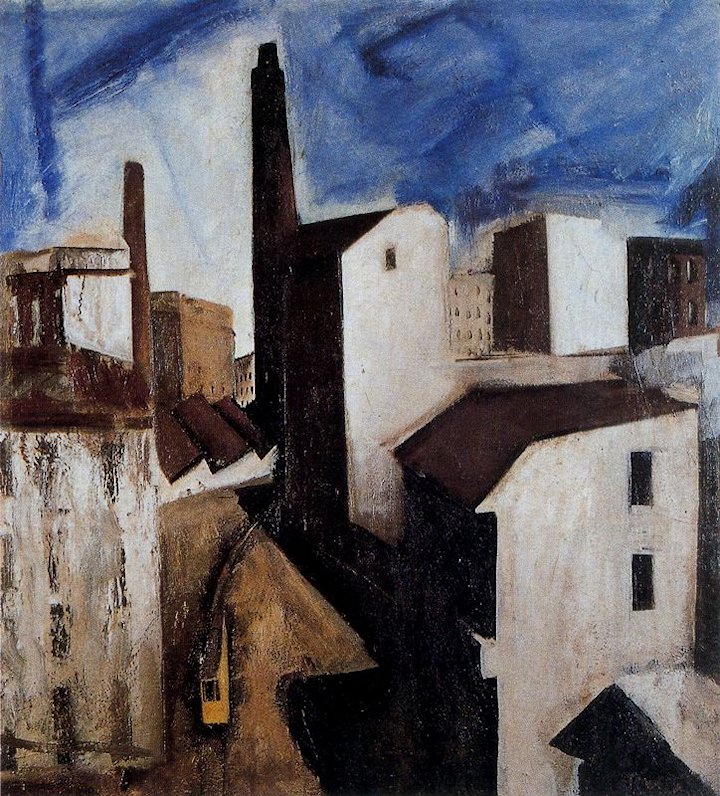
Mario Sironi (1885 - 1961)


The eyes are not here
There are no eyes here
In this valley of dying stars
In this hollow valley
This broken jaw of our lost kingdoms

In this last of meeting places
We grope together
And avoid speech
Gathered on this beach of the tumid river

Sightless, unless
The eyes reappear
As the perpetual star
Multifoliate rose
Of death’s twilight kingdom
The hope only
Of empty men.

T. S. Eliot (1888 - 1965)
From The Hollow Men


Friday, January 11, 2013

For the time the dream allowed


You weren't well or really ill yet either;
just a little tired, your handsomeness
tinged by grief or anticipation, which brought
to your face a thoughtful, deepening grace.

I didn't for a moment doubt you were dead.
I knew that to be true still, even in the dream.
You'd been out--at work maybe?--
having a good day, almost energetic.

We seemed to be moving from some old house
where we'd lived, boxes everywhere, things
in disarray: that was the story of my dream,
but even asleep I was shocked out of the narrative

by your face, the physical fact of your face:
inches from mine, smooth-shaven, loving, alert.
Why so difficult, remembering the actual look
of you? Without a photograph, without strain?

So when I saw your unguarded, reliable face,
your unmistakable gaze opening all the warmth
and clarity of you--warm brown tea--we held
each other for the time the dream allowed.

Bless you. You came back, so I could see you
once more, plainly, so I could rest against you
without thinking this happiness lessened anything,
without thinking you were alive again.

Mark Doty (1953 - )
The Embrace


Friday, December 28, 2012

I must go down to the seas again

I have this thing about sailors. Perhaps because my family has a history of sea-faring. My grandfather, one uncle and a cousin were all master mariners; others in the family held various positions in the merchant marine. Even my father went to sea - once and only once - as a deck boy when he was 16. Then again, perhaps it's the uniform. Who knows.

All images have full size views. Just click on any one


I must go down to the seas again, to the lonely sea and the sky,
And all I ask is a tall ship and a star to steer her by,
And the wheel's kick and the wind's song and the white sail's shaking,
And a grey mist on the sea's face, and a grey dawn breaking.

I must go down to the seas again, for the call of the running tide
Is a wild call and a clear call that may not be denied;
And all I ask is a windy day with the white clouds flying,
And the flung spray and the blown spume, and the sea-gulls crying.

I must go down to the seas again, to the vagrant gypsy life,
To the gull's way and the whale's way, where the wind's like a whetted knife;
And all I ask is a merry yarn from a laughing fellow-rover,
And quiet sleep and a sweet dream when the long trick's over.

John Masefield (1878 - 1967)
Sea Fever


Saturday, December 15, 2012

Thomas Eakins (1844 - 1916): The male figure


We two boys together clinging,
One the other never leaving,
Up and down the roads going,
North and South excursions making,
Power enjoying, elbows stretching, fingers clutching,
Arm'd and fearless, eating, drinking, sleeping, loving.
No law less than ourselves owning, sailing, soldiering, thieving, threatening,
Misers, menials, priests alarming, air breathing, water drinking, on the turf
or the sea-beach dancing,
Cities wrenching, ease scorning, statutes mocking, feebleness chasing,
Fulfilling our foray.

Walt Whitman (1819 - 1892)
We two boys together clinging


Eakins, of course, painted and photographed more than the male figure, but he captures its beauty, particularly in his boxer paintings. This applies equally to the final painting of his friend and student John Laurie Wallace, who in this pose isn't the same idealized figure as those in the wrestling or boxing paintings.

Friday, December 14, 2012

O'er the unknown sea


Some time at eve when the tide is low,
I shall slip my mooring and sail away,
With no response to the friendly hail
Of kindred craft in the busy bay.
In the silent hush of the twilight pale,
When the night stoops down to embrace the day,
And the voices call in the waters’ flow

Some time at eve when the tide is low,
I shall slip my mooring and sail away.
Through the purpling shadows that darkly trail
O’er the ebbing tide of the unknown sea,
I shall fare me away, with a dip of sail
And a ripple of waters to tell the tale
Of a lonely voyager, sailing away
To the mystic isles where at anchor lay
The crafts of those who have sailed before
O’er the unknown sea to the unknown shore.

A few who have watched me sail away
Will miss my craft from the busy bay;
Some friendly barks that were anchored near,
Some loving souls that my heart held dear,
In silent sorrow will drop a tear;
But I shall have peacefully furled my sail
In mooring sheltered from storm and gale
And greet the friends who have sailed before
O'er the unknown sea to the unknown shore.

Elizabeth Clark Hardy (1849 - 1929)
The Unknown Shore


Tuesday, December 04, 2012

And swam for Love


If, in the month of dark December,
Leander, who was nightly wont
(What maid will not the tale remember?)
To cross thy stream, broad Hellespont!

If, when the wintry tempest roared,
He sped to Hero, nothing loath,
And thus of old thy current poured,
Fair Venus! how I pity both!

For me, degenerate modern wretch,
Though in the genial month of May,
My dripping limbs I faintly stretch,
And think I’ve done a feat today.

But since he crossed the rapid tide,
According to the doubtful story,
To woo—and—Lord knows what beside,
And swam for Love, as I for Glory;

’Twere hard to say who fared the best:
Sad mortals! thus the gods still plague you!
He lost his labour, I my jest;
For he was drowned, and I’ve the ague.
Lord George Gordon Byron (1788 - 1824)
Written After Swimming From Sestos To Abydos


Sunday, December 02, 2012

The woods are lovely


Whose woods these are I think I know.
His house is in the village though;
He will not see me stopping here
To watch his woods fill up with snow.

My little horse must think it queer
To stop without a farmhouse near
Between the woods and frozen lake
The darkest evening of the year.

He gives his harness bells a shake
To ask if there is some mistake.
The only other sound's the sweep
Of easy wind and downy flake.

The woods are lovely, dark, and deep.
But I have promises to keep,
And miles to go before I sleep,
And miles to go before I sleep.
Robert Frost (1874 - 1963)
Stopping by Woods on a Snowy Evening

After the first snow of the season I thought this was an appropriate post. I always like that first snow, before the traffic gets to it and makes it grey or, as now, when the weather warms and turns it to slush. I was up at 3:00 a.m., wandering the house, and when I looked out the streetlights were hazy and glowing, their glare softened by the falling snow. The road was deserted and the only evidence of life I saw were some tracks leading up the front walk, possibly a rabbit or perhaps a cat. My woods are my neighbours' houses, my trees are interspersed with telephone poles, but I felt the same sense of tranquility that briefly took hold of Frost before the world called him away.

Saturday, November 24, 2012

Charles Demuth (1883 - 1935)

O to have my life henceforth a poem of new joys!
To dance, clap hands, exult, shout, skip, leap, roll on, float on,
To be a sailor of the world, bound for all ports,
A ship itself, (see indeed these sails I spread to the sun and air,)
A swift and swelling ship, full of rich words—full of joys.

Walt Whitman (1819 - 1892)
Poem of Joys


"Demuth was not a flaming queen, in fact he was rather a discreet gay, but if he could not place his deepest sexual predilections in the open, he could still make art from them. Seen from our distance, that of a pornocratic culture so drenched in genital imagery that sly hints about forbidden sex hardly compel attention, the skill with which he did this might seem almost quaint."